After its introduction in 2008, StimTracker became key to integrating a psychophysiology lab, offering the first true plug-and-play solution for EEG recorders, eye trackers, NIR, and other recorders.
Feedback started pouring in. Some didn’t need all the features and wanted lower cost solutions. For them, we introduced last month our new c–pod and m–pod products. But other users needed even more features.
Today, I’m happy to announce StimTracker 2G, our next generation model, due out this coming October. The 2G model implements all the features requested by users.
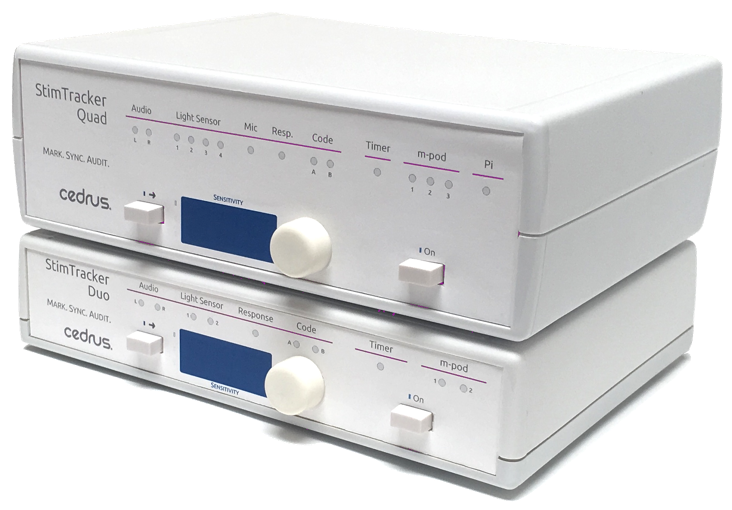
StimTracker 2G comes in two models: Duo and Quad. StimTracker Duo offers dual outputs; StimTracker Quad gets you four outputs, with a possible fifth option (hint: a π); more on that below.
StimTracker (both old and new) accepts five sources of input: light sensors, audio, microphone voice key, key press information from an RB response pad, and USB event codes. The most vocal feedback about StimTracker 1G had to do with what input sources are being made available to the output, e.g. “why am I limited to 3 bits of USB event codes? I want all 8!”. Or, “I want to use all 4 light sensors”. So without further ado:
Configurable Output: TTL output from StimTracker 2G is now delivered using m–pod. This means that you can now map any input signal to any TTL output pin. You can even map several input signals to a single output pin. Cool stuff.
Multiple Outputs: The Duo supports simultaneous output to two m–pods. Quad supports output to three m–pods and a fourth general purpose TTL output.
Raspberry Pi Support (Quad only): For the tinkerer in you, you can add a Raspberry Pi board inside StimTracker Quad, allowing event markers to be sent over Ethernet, e.g. to other devices via labstreaminglayer (LSL). We cannot provide software support for the Pi, but at least the option is present.
Full Voice Key (Quad only): Upon detecting the onset of a vocal response, the 1G model would send a TTL signal out, leaving SuperLab or other stimulus presentation software in the dark. StimTracker Quad will additionally send voice key onset information to the computer via USB.
Timeline Auditing: The new StimTracker can send time-stamped information to the computer via USB, providing an audit trail of exactly when stimuli were presented or participants responded.
StimTracker 2G also includes all the new software features found in c–pod. There are other improvements as well, e.g. the ability to set the analog thresholds via software commands and the use of 4-layer circuit boards (instead of 2) to improve noise immunity.
Three things.
The Duo model is housed in a thinner enclosure. Due to space and cost considerations, the voice key feature is now found in the Quad model only. For the same reasons, the Duo supports only two light sensors instead of four.
Also on the Quad model, the microphone and light sensor 4 share the same connector. You can use four light sensors and no voice key, or three light sensors with voice key.
And last, the big, bulky signal adapter blocks are gone and replaced by m–pod.
The table highlights the differences only; it is not a complete list of features.
StimTracker Duo is $1,995. StimTracker Quad is $2,495. The price for both includes one m–pod model of your choice. They will be available this October.
StimTracker
Quad
3 + 1

8
3
1
StimTracker
Duo
2
—

2
—
StimTracker
original
4
6
—
1
Feature
Number of light sensor inputs
Compatible with RB-x40 response pads
Original model accepts input from older RB-x30 models
Number of external TTL inputs that can be marked
Full voice key support
Number of simultaneous m–pod outputs
Configurable output
Number of Direct TTL outputs
Time-stamped output via USB
Supports optional Raspberry Pi board
PRODUCTS
SUPPORT
STAY IN TOUCH


© Copyright 2026 Cedrus Corporation, P.O. Box 6309, San Pedro, CA 90734 - USA
Phone: +1-310-548-9595. Send us an email
qwerasdf